Presented by Carahsoft
Brigadier General Reid Novotny, Chief Artificial Intelligence Officer at U.S. Cyber Command and the Department of War's Cyber Force Generation Lead, joined host Francis Rose at TechNet Cyber 2026 to detail Cybercom 2.0 — an ambitious initiative to fundamentally reform how the cyber mission force is built, sustained, and rewarded.
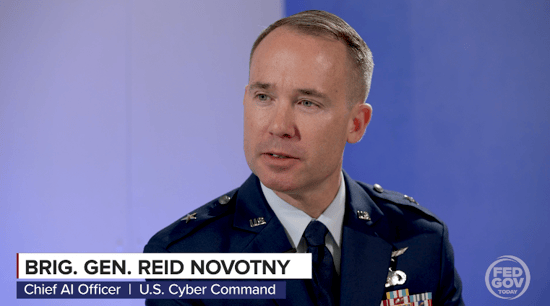 Novotny was clear that Cybercom 2.0 is not a top-down Pentagon mandate — it grew organically from the ground up, driven by the people in the domain who understood what needed to change. Young sailors, marines, soldiers, and airmen working in cyber have long raised concerns about inequitable incentive pay and limited pathways to technical mastery. Cybercom 2.0 is designed to address those concerns systematically, starting with getting incentive pay right and standardized across the services — a goal that required both budgetary investment and technical changes to training and tracking databases. The target: paying the right members at the right time with the right amount of money, beginning October 1, FY27.
The initiative's "optimized unit phasing" attribute addresses a related problem — operational burnout. Cyber mission force units have historically been "continuously presented," meaning members are on the clock 365 days a year with no structured rotation. Cybercom 2.0 changes that by implementing a sustainable operational tempo — rotating units off, allowing for rest, training, and recovery, then bringing them back sharper and more capable than before. Novotny was direct: burning through people is not a strategy.
The third major organizational pillar Novotny discussed was the Cyber Innovation Warfare Center (CWIC), which embeds operators, developers, and industry partners together to identify, procure, and field emerging technology at speed. Rather than waiting for programs to mature through traditional acquisition cycles, CWIC is designed to get technology into the hands of operators faster — with the right contracting vehicles to match. Novotny noted that the organization is running and building simultaneously, delivering results even as it stands up.
Key Takeaways:
- Cybercom 2.0's incentive pay reform — targeting FY27 implementation — aims to standardize and equalize pay across services for cyber work roles, a first-of-its-kind effort for the Department of War.
- Optimized unit phasing introduces structured rotation cycles for cyber mission force units, replacing the unsustainable 365-day continuous-presence model with a rhythm of operation, recovery, and training.
- The Cyber Innovation Warfare Center (CWIC) embeds operators and industry partners together to accelerate technology fielding — putting innovation directly in the hands of those executing the mission.