Presented by Carahsoft
Federal agencies are moving rapidly toward fully digital operations, and records management is at the center of that shift. What was once viewed primarily as a compliance requirement is now a strategic function tied directly to data quality, artificial intelligence, cybersecurity, transparency, and mission outcomes. Throughout this episode of Innovation in Government, government leaders and industry experts discuss how records are becoming dynamic data assets that must be governed, secured, and leveraged across their entire lifecycle. The conversations highlight how agencies are modernizing technology, rethinking workforce roles, and adopting automation to meet digital mandates while strengthening trust in government information.
Records as Data in the Age of AI
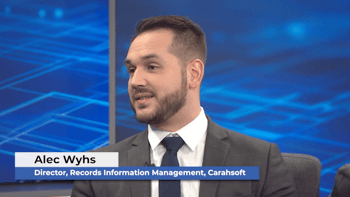 Records management is no longer operating on the sidelines of government data strategy. Alec Wyhs, Director of Records Information Management at Carahsoft, explains that the rise of artificial intelligence has fundamentally changed how agencies must think about records. AI depends on large volumes of well-organized, high-quality data, and records represent one of the most valuable sources agencies have. Treating records as part of the broader data lifecycle—rather than as a separate category—positions agencies to take advantage of analytics, automation, and AI-driven insights.
Nate Hughes, CEO of ARMA International, reinforces the importance of enterprise-wide information governance. Successful records and data programs depend on executive leadership and alignment across CIOs, CDOs, and other senior officials. Without consistent frameworks, agencies risk creating fragmented systems that undermine confidence in the data used for decision-making. Metadata, tagging, and governance have always  mattered, but they are now essential to ensuring AI produces reliable results.
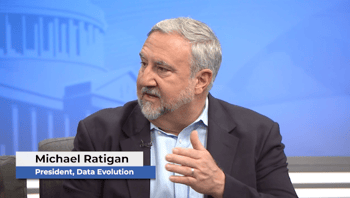
Michael Ratigan, President of Data Evolution, highlights how AI is breaking down long-standing silos between records management, FOIA, privacy, and governance. Automated tagging, classification, and redaction allow technology to handle repetitive tasks while professionals focus on judgment and oversight. Together, the discussion underscores how records have become foundational assets in a data-driven government.
 Key Takeaways
-
Records are critical data assets that must support AI and analytics initiatives.
-
Enterprise governance and leadership alignment are essential for success.
-
AI can automate records processes while improving accuracy and efficiency.
AI and Records Management at the Department of Defense
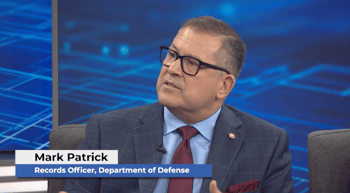 At the Department of Defense, the scale and complexity of information demand automation. Mark Patrick, Records Officer at the Department of Defense, describes how the growing volume and diversity of records require new approaches to curation, governance, and trust. As generative AI tools become available across the department, ensuring that data used by those tools is accurate and reliable has become a priority.
Patrick explains that records management is being built into systems earlier in their lifecycle, rather than addressed after the fact. This shift helps preserve institutional memory, reduce long-term risk, and avoid costly challenges when systems are retired. Decisions about digitizing legacy records are driven by business value, operational need, and records retention requirements, especially as NARA moves away from accepting paper records.
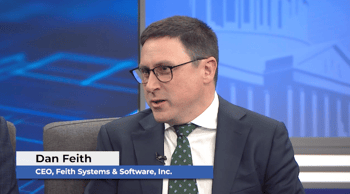 Dan Feith, CEO of Feith Systems & Software, Inc., describes how AI adds value to human-generated content such as reports, correspondence, and analysis. Once digitized, AI can summarize content, extract key insights, and make information searchable at scale. The conversation highlights how AI enables faster decision-making and turns records management into a strategic capability that supports defense missions.
Key Takeaways
-
Automation is essential to managing records at DoD scale.
-
Records management must be planned into systems from the start.
-
AI enables faster access to critical information and decision support.
Security, Access, and Trust in Government Information
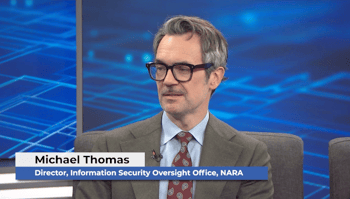 Balancing information protection with accessibility remains one of government’s biggest challenges. Michael Thomas, Director of the Information Security Oversight Office at NARA, explains ISOO’s role in overseeing how classified and controlled unclassified information is handled across agencies. With limited staffing and growing data volumes, technology has become a necessity rather than an option.
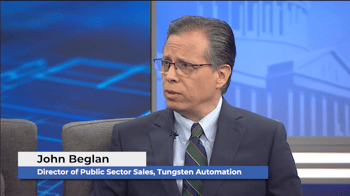
John Beglan, Director of Public Sector at Tungsten Automation, describes how automation supports agencies by reducing reliance on manual processes. Modern platforms manage information from ingestion through workflow and storage, allowing agencies to scale operations while maintaining human oversight. Automation helps agencies meet compliance requirements while turning information into a strategic resource.
 Trust is a recurring theme throughout the discussion. Internally, agencies must trust that automated tools apply protections correctly. Externally, the public must trust that government information will be released accurately and in a timely manner. Standardization and interoperability make it possible to gain better visibility into how information is managed and to demonstrate accountability across government.
Key Takeaways
-
Automation helps agencies manage sensitive information with limited staff.
-
Trust depends on transparency, consistency, and human oversight.
-
Standardized practices improve accountability and system health.
The Evolution of Records Management and the Workforce
 Records management has changed dramatically over the past several decades. Susan Little, Former Director of Data and Records Compliance at HHS, reflects on a profession that once focused primarily on archiving paper records. Today, records managers are deeply involved throughout the information lifecycle, supporting mission operations, legal requirements, and data governance from creation through disposition.
Keith Nelson, Head of Public Sector at OpenText, describes how automation is reshaping daily work. Zero-click records management reduces reliance on employees to manually tag, sort, and file records, allowing systems to handle those tasks automatically. This approach improves consistency, reduces errors, and frees records professionals to focus on oversight and strategy.
 Both speakers emphasize that records management is now central to AI readiness. AI cannot deliver value unless information is digitized, organized, and governed effectively. As technology continues to advance, records professionals must remain adaptable and technologically fluent. Capabilities such as auto-redaction, intelligent categorization, and deduplication are already changing how agencies manage information and prepare for the future.
Key Takeaways
-
Records management has become a strategic, lifecycle-based discipline.
-
Automation reduces manual effort and improves reliability.
-
Strong records foundations are essential for AI and future innovation.