

Presented by HII Mission Technologies
DefenseTech TV presented by HII Mission Technologies examines how the defense community is moving from discussion to execution on the technologies shaping the future fight. Recorded on location at DefenseTech LIVE, this program explores the urgent push to deliver capability faster to the warfighter while integrating autonomy, artificial intelligence, resilient networks, spectrum access, open architectures, and data-driven decision tools into real operational environments. Across the conversations, a consistent theme emerges: speed is not only about buying technology faster. It is about building the architectures, policies, partnerships, and trust needed to make new capabilities useful at the point of need.
The program highlights how leaders across government, industry, research, and the national security community are thinking about decision advantage in a more contested and complex world. Autonomous systems are expanding what individual warfighters can see and control. AI is helping operators manage overwhelming amounts of data. Open systems are becoming essential to interoperability and avoiding vendor lock. Spectrum is emerging as maneuver space. At the same time, adversaries are using low-cost robotic weapons, drones, and distributed systems to challenge traditional U.S. advantages. The result is a defense technology landscape where integration, speed, and adaptability are no longer future goals — they are immediate operational requirements.
Airpower in the Age of Speed
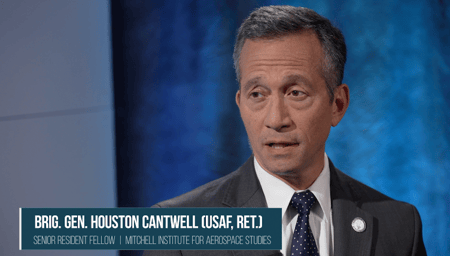 Brig. Gen. Houston Cantwell, USAF (Ret.), Senior Resident Fellow for Airpower Studies at the Mitchell Institute for Aerospace Studies, explains that autonomy is not a new discussion for the Air Force. For decades, the service has explored how advanced aircraft, both manned and unmanned, can use automation to improve mission effectiveness. What has changed is the urgency around integrating those capabilities in ways that serve the warfighter directly.
Cantwell says the most important conversation is not simply whether the military should use autonomy, but where automation belongs inside the kill chain. The traditional sequence of find, fix, target, track, engage, and assess has historically relied on human judgment at every stage. Now, the challenge is determining where machines can accelerate decisions, process information, and create time for human operators to apply judgment in the most consequential moments.
He notes that the public discussion often focuses narrowly on whether a machine should ever “push the button.” Cantwell argues that is only one piece of a much broader question. In some defensive scenarios, especially mass attacks involving large numbers of drones, missiles, or other threats, humans may not have enough decision space to respond manually to each target. In those cases, automation may be necessary to defend forces and infrastructure.
The conversation also turns to data. Cantwell says the right information must reach the right decision maker at the right time, but the volume of data and the vulnerability of data links create risk. As military systems rely more heavily on unmanned platforms, commercial networks, and distributed sensors, the data foundation itself can become an operational weakness if it is not protected and managed effectively.
Key Takeaways
- Autonomy in airpower is not new, but the urgency around useful integration has accelerated.
- The real autonomy question is where machines can speed the kill chain while preserving human judgment where it matters most.
- Data links, commercial networks, and information flow are becoming central vulnerabilities in modern air operations.
Open Architectures and the Future of Manned-Unmanned Teaming
 John Bell, Chief Technology Officer for HII Mission Technologies, says autonomous and unmanned systems are among the most important technologies reshaping the defense landscape. The shift is not limited to drones or air vehicles. Bell points to unmanned systems across air, surface, and subsurface domains, and says their greatest value may be in augmenting manned forces, handling dangerous or repetitive missions, and enabling commanders to use people more effectively.
Bell describes a future in which the human operator is less often “in the loop” for every action and more often “on the loop,” supervising autonomous systems and providing commander’s intent. That shift requires more than advanced platforms. It requires integration across systems that were not always designed to work together. Bell says the Department of Defense increasingly wants to take advantage of commercial capabilities, but many commercial products were not built from the ground up for military interoperability.
That makes modular open systems architecture, or MOSA, central to future force design. Bell explains MOSA as breaking systems into components and clearly defining how each component interoperates with the others. Companies can still protect their proprietary “secret sauce,” but the interfaces between systems need to be open and available so the broader mission architecture can work.
Bell says the defense community has moved from skepticism to momentum on MOSA because leaders have seen it work. He points to HII’s work on the Army’s Enduring High Energy Laser program as an example of designing with open architecture from the start. By sharing interface specifications with the government and vendors, the program can draw from multiple suppliers, encourage competition, and avoid a closed system that limits future flexibility.
Key Takeaways
- Manned-unmanned teaming is changing how commanders use people, platforms, and autonomous systems.
- Open interfaces are essential if commercial and defense technologies are going to operate together.
- MOSA allows industry to protect proprietary capabilities while giving the government more flexibility and interoperability.
Autonomy Beyond the Fight: Readiness, Sustainment, and the Data Advantage
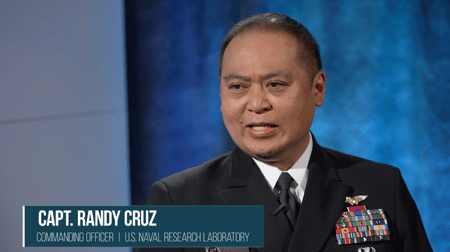 Capt. Randy Cruz, Commanding Officer of the U.S. Naval Research Laboratory, says autonomy is often discussed in the context of combat, but its value extends across the full spectrum of naval readiness and sustainment. One of his clearest examples is ship inspection. Traditionally, ballast tank inspections can require ships to be taken out of service, tanks to be emptied, and personnel to enter difficult environments. Cruz explains that autonomous inspection systems, imagery, and algorithms can help determine whether a ship needs repair or can return to sea more quickly.
That example captures a broader point: autonomy should not be adopted because it is new or exciting. It should be applied to specific operational problems. Cruz says the Naval Research Laboratory’s scientists start with the mission challenge and then determine whether autonomy, artificial intelligence, robotics, sensors, or another technology can help solve it.
Cruz also describes how the laboratory aligns its work with Navy priorities, including the CNO’s fighting instructions and the department’s critical technology areas. He says NRL’s portfolio spans from seabed to space, including cyber, quantum sensing, resilient networks, and undersea technologies. The common thread is helping the Navy prepare for a multi-domain fight in which data, communications, sensing, and decision advantage are essential.
Looking ahead, Cruz says resilient networks are one of the most important areas of focus. As more data moves across different networks and constellations, the Navy must ensure that information is accurate, timely, and available to the right decision makers. He emphasizes that the goal is not simply to collect more information, but to move the right data to the right people at the right time.
Key Takeaways
- Autonomy can improve readiness and sustainment, not just combat operations.
- NRL’s approach starts with mission problems, then applies the right technology to solve them.
- Resilient networks and trusted data flows are essential to future naval decision advantage.
Putting the Warfighter at the Center of Autonomy and AI
 Grant Hagen, President of Warfare Systems for HII Mission Technologies, says autonomy and artificial intelligence should be understood first through their impact on the warfighter. Autonomous systems can dramatically expand the reach of a single operator. Hagen describes a future in which one warfighter may supervise unmanned underwater vehicles, unmanned surface systems, robotic ground platforms, and sensors across the battlespace.
That expansion creates enormous opportunity, but it also creates risk. More sensors mean more data, and more data can overwhelm the operator if it is not organized and prioritized. Hagen says AI tools are becoming essential to help warfighters understand what matters most. Instead of manually directing every asset, the human operator can act more like a strategic supervisor, focusing on priorities while autonomous systems carry out assigned tasks.
Hagen says the infrastructure behind that vision must be invisible to the user. The warfighter should not have to worry about how systems connect, how data flows, or how platforms integrate. That requires interoperability, open interfaces, and modular architectures. If systems from different companies arrive on the battlefield, they must be able to work together and feed a broader system that can process and present data in useful ways.
He also notes that industry and government need to build interoperability into requirements from the start. Without that discipline, programs can drift into vendor lock, limiting flexibility and slowing future upgrades. Hagen says HII’s experience as an integrator informs its approach. Shipbuilding has always required bringing together systems built by different providers, and that same mindset is now essential across autonomous and AI-enabled defense systems.
Key Takeaways
- Autonomy can turn one warfighter into the supervisor of many distributed systems.
- AI is essential to prevent operator overload and prioritize battlefield information.
- Interoperability must be built into requirements early to avoid vendor lock and preserve speed.
Spectrum on Demand: Building Maneuver Space for the Connected Force
 Art DeLeon, Director of Strategic Spectrum Policy for the Department of the Navy CIO, says the defense community must rethink how it manages spectrum. Historically, spectrum access has often depended on static frequency assignments. A unit may reserve a frequency for 24 hours and only use it for a small portion of that time. DeLeon says that model does not match the needs of modern operations, where forces require dynamic, automated access to communications and electronic warfare capabilities.
DeLeon describes spectrum as the backbone of communications, electronic warfare, unmanned systems, and connected operations. He argues that the department does not simply have a frequency problem; it has a bandwidth problem. The issue is not just whether a specific user can access a specific frequency, but whether the broader network can use available bandwidth efficiently and route communications through the best available path.
To get there, DeLeon says the culture and regulatory framework around spectrum must change. Legacy rules often define frequency use by service or application, reinforcing the idea that a portion of bandwidth belongs to one user or mission. DeLeon says future operations require spectrum-on-demand: automated, open, flexible access that creates maneuver space and allows systems to connect when and where they are authorized.
He compares the desired end state to the way modern cellular and Wi-Fi systems work for users today. If someone is provisioned and authenticated, the network connects them. DeLeon says defense systems need similar seamlessness across installations, tactical environments, and global operations. That means moving away from manual permission processes and toward system-to-system connections that deliver the bandwidth warfighters need.
Key Takeaways
- Static frequency assignment is too slow and inefficient for modern military operations.
- The real challenge is creating bandwidth and maneuver space across the spectrum.
- Spectrum-on-demand will require automation, open architectures, and cultural change.
Speed, Integration, and Homeland Defense in a New Technology Era
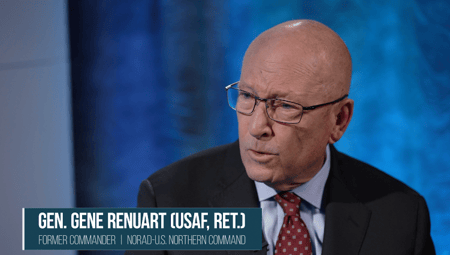 Gen. Gene Renuart, USAF (Ret.), former Commander of NORAD and U.S. Northern Command, says the Department of Defense must find ways to move faster without waiting for a full overhaul of the acquisition system. He points to tools such as Other Transaction Authority as a way to target money toward specific needs, deliverables, and timelines that better match warfighter demand.
Renuart says the urgency around speed is especially visible in unmanned systems. He points to recent examples of unmanned maritime systems being used in ways that would have seemed unconventional not long ago, including combat search and rescue. But he also emphasizes that human judgment remains central. Unmanned systems, sensors, space assets, and optical systems may provide inputs, but commanders still need the ability to coordinate, decide, and execute.
Integration is the core challenge. Renuart says legacy systems such as Link 16 have been overloaded by the growing number of inputs commanders must manage. Future operations will require new ways to sort, prioritize, and deliver information. He says artificial intelligence can help process what matters, separate useful signals from noise, and push decision-quality information down to the tactical edge.
The homeland defense mission adds another layer of complexity. For a commander responsible for threats from space to subsurface, across the Arctic, North America, and surrounding approaches, rules of engagement must be clear, legal, and flexible. Renuart says homeland defense involves unique legal authorities, binational responsibilities, and relationships with allies and partners. As new technologies enter that mission space, leaders must preserve speed while also protecting innocent life, legal frameworks, and international relationships.
Key Takeaways
- Speed to the warfighter may require broader use of flexible acquisition tools.
- AI can help commanders manage the growing volume of sensor and network inputs.
- Homeland defense adds legal, operational, and binational complexity to unmanned systems integration.
From Experimentation to Force Generation: Making Autonomy Operational
 Bryan Clark, Senior Fellow at Hudson Institute, says the autonomy conversation has matured. The central question is no longer whether the Navy and other services should buy autonomous systems. The harder question is how to deploy them, integrate them with operational forces, and use them to solve real combatant commander problems.
Clark points to the idea of tailored forces as one practical path forward. Instead of trying to integrate autonomous systems across the entire Navy all at once, leaders can create focused force packages built around specific missions. These packages may combine mostly autonomous systems with a smaller number of manned platforms for command, control, or support. Clark says that approach makes the integration problem more manageable.
He says progress is being driven by both operational pull and technology push. Combatant commanders want capabilities that can solve urgent problems, while industry and technology developers are investing heavily in unmanned and autonomous systems. The missing middle has been force generation: the concept development, training, equipping, experimentation, and deployment process that turns technology into usable operational capability.
Clark says accountability matters. Senior leaders have identified the need to generate robotic and autonomous systems in the same way the Navy generates ready submarines, ships, and aircraft. But that requires empowered leaders who can own the mission and move systems from the continental United States to forward operating environments where they are needed.
He also identifies contracting and open architecture as barriers. Acquisition decisions may happen quickly, but contracts and funding can lag. At the same time, systems must be designed with open interfaces so they can interoperate across providers. Without enforcement at the program level, Clark warns, autonomous systems may bunch up before they ever reach the field.
Key Takeaways
- The autonomy challenge has shifted from buying systems to operationally deploying them.
- Tailored force packages can make integration more manageable.
- Contracting speed and enforced open interfaces are essential to moving autonomous systems into the field.
Robotic Weapons and the New Logic of Military Advantage
 George Dougherty, author of Beast in the Machine and former Director of Innovation for C3 and Battle Management at the Air Force, says recent conflicts show why there is urgency around autonomy, artificial intelligence, and robotics. He points to Iran, the Houthis, and Ukraine as examples of how low-cost, smart, lethal robotic weapons can help weaker actors challenge more advanced militaries.
Dougherty says Iran and its proxies have used this first wave of robotic military capability to level the playing field in ways the United States has not historically encountered. These systems do not need to match U.S. platforms one-for-one. They only need to be cheap, accessible, lethal, and persistent enough to complicate U.S. operations and impose costs over time.
The Houthis are a clear example. Dougherty notes that the U.S. Navy has faced some of its most intense naval combat since World War II against a militia group that would not traditionally be considered a near-peer military threat. That reality, he says, should be a warning. If relatively small actors can use cheap robotic weapons to challenge advanced navies and air forces, the United States must adapt quickly.
Dougherty also agrees that adversaries do not need equivalent force projection to create strategic problems. They may simply need to keep the United States engaged long enough to wear down political will, strain resources, or deter future action. Countries such as Iran, Russia, and China may believe they can absorb punishment longer than the United States is willing to sustain a fight.
For defense leaders, the lesson is that the first wave of robotic weapons is about the commoditization of lethality. Smart munitions, drones, and robotic fires are becoming more available to a wider range of actors. Dougherty says the United States must move beyond reacting to that trend and think more deeply about how autonomy, AI, and robotics can reshape future military advantage.
Key Takeaways
- Low-cost robotic weapons are giving weaker actors new ways to challenge advanced militaries.
- Iran, the Houthis, and Ukraine offer urgent lessons about the changing character of conflict.
- The United States must move beyond matching cheap systems and rethink how robotic capability restores military advantage.